No Products in the Cart


Music and sound have an enormous impact on spatial perception – whether in the reception area, meeting room, or retail store. They shape atmosphere, perception, and ultimately, the customer experience. Nevertheless, audio is often underestimated in spatial planning – with audible, design-related, and sometimes financial consequences.
Yet, much can be achieved through structured audio planning. We show what matters – and how WHD's digital tools effectively support specialist planners, architects, and installers.
Room size and acoustics: Depending on the architecture and acoustic properties, suitable loudspeaker solutions are needed. While hard-surfaced areas require special measures, fewer loudspeakers may suffice in acoustically damped rooms.
Suitable loudspeaker types: Not every loudspeaker is suitable for every location. Small models are sufficient in meeting rooms, while open retail spaces require more power and even distribution.
Media integration and control: Modern audio solutions should integrate multiple sources such as streaming services, network audio, or TV. Simple control – for example, via app or touch panel – increases acceptance in everyday use.
Design and visibility: In representative areas, visual integration is crucial – whether visibly integrated into the interior or invisibly installed in ceilings and walls.
Distinction between indoor and outdoor areas: For outdoor areas, weatherproof loudspeakers are necessary that match the surroundings both acoustically and visually.
In practice, problems often arise that could easily be avoided with professional planning:
Too few or incorrectly placed loudspeakers, leading to uneven sound distribution
Unsuitable cabling, such as overly long lines or thin cables, which can impair sound quality
Unclear requirements, for example for multi-zone or background sound, often lead to costly retrofits
A structured planning process can identify and resolve these risks early on – saving time and costs.
To ensure smooth audio planning, WHD offers digital tools that are tried and tested in practice – and available free of charge:
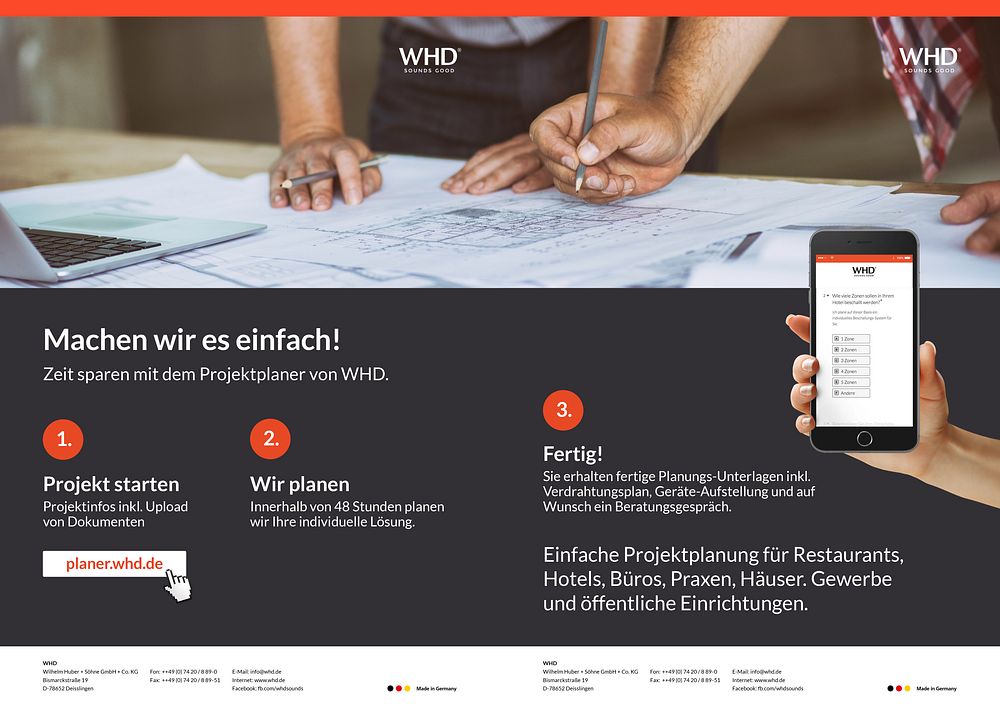
🎯 The WHD Project Planner
Ideal for architects, electricians and specialist planners. Simply start online and within 48 hours you will receive:
➡ More than 1,000 successful projects already show: The project planner saves time and ensures better results.
Across 100 pages, the guide bundles knowledge, practical tips, and checklists for commercial, public, and private sound reinforcement projects.
Ideal for anyone planning professionally or seeking a solid foundational knowledge.
We are a medium-sized company with over 40 specialists, 90 years of experience, and more than a thousand projects.
With the Project Planner, you can easily have your audio projects planned by WHD. It's free, digital, and convenient for you.
Our solutions offer benefits for many industries and applications, create added value, and are proven.


 German
 English
 French
 Spanish
 Italian
 Danish
 Dutch
Dutch Swedish